



Security in Munich in 2025: good, but more burglaries!
27. March 2026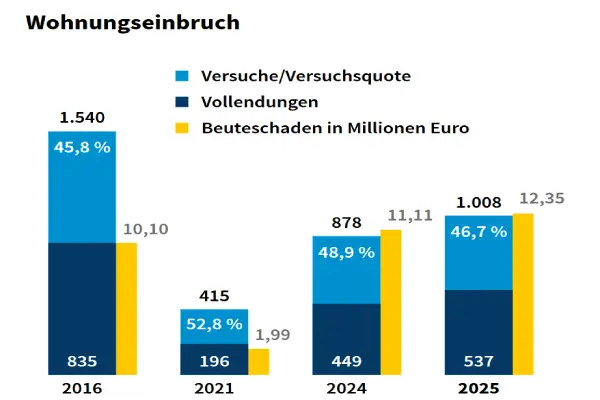
Development of residential burglaries in Munich from 2016 to 2025
Good security level
Munich remains—now for the 50th consecutive year—the safest major city in Germany. It sounds like a long-running subscription to first place, and in a way, it is: no comparable metropolis has a lower risk of becoming a victim of crime. While the city already performs well, the surrounding district performs even better.
Overall crime decreased slightly in 2025: 98,478 offenses (excluding immigration law violations) represent a drop of 1.8%, and the crime frequency rate also fell by 2.2%. At the same time, the clearance rate rose to 62.9%, a solid increase and clear evidence that investigative work is not only diligent but also effective.
Residential burglaries are rising
The picture is more nuanced when it comes to burglary. Residential burglaries increased by 14.8%—not a flattering result, but also not a reason for panic: in a ten-year comparison, the figures are still significantly below the 2016 level (–34.5%). In addition, almost every second attempted burglary fails (46.7%), showing that prevention measures are having an effect.
The clearance rate for burglaries overall also improved slightly to 33.1% (previously 32.6%), meaning roughly one in three cases is solved. For residential burglaries specifically, it remains relatively low at 16.2%, which highlights the complexity of these offenses.
A closer look reveals that not all categories are increasing. Declines were recorded in new builds and shell construction sites (–190 to 248 cases) and in basements or ancillary rooms (–226 to 1,317 cases). Slight increases were seen in offices and workshops (+11 to 673 cases) and—on a very low level—in banks and post offices (+1 to 4 cases). Particularly notable: burglaries in restaurants, hotels, and canteens reached a ten-year high with 279 cases.
Despite isolated increases, combating residential burglary remains a priority. Accordingly, cross-border cooperation is close—and it is proving effective. A large proportion of suspects operate internationally: 69.7% of identified burglars were not German nationals. In addition, around 61.4% of suspects did not live in Munich or their whereabouts were unclear, with a significant share even residing abroad.
Overall, it also becomes clear why burglaries are taken so seriously: property damage reached a new high of €12.35 million in 2025. However, this is less a sign of widespread looting and more the result of a few cases involving particularly high losses.
Prevention of residential burglaries
In 2025, police placed increased emphasis on prevention in order to counter burglary and theft offenses at an early stage. Through targeted campaigns and new posters, citizens and property managers were informed about how to securely store bicycles and how to respond in the event of theft.
A particular focus was placed on high-risk areas such as basements and bicycle storage rooms. At the same time, the police security watch increased its presence and acted as a visible deterrent to potential offenders.
In addition, targeted measures were implemented to prevent residential burglaries, especially during evening hours and in particularly affected areas. Through this combination of information, presence, and targeted deterrence, the police consistently pursue the goal of preventing crimes before they occur.
Source: